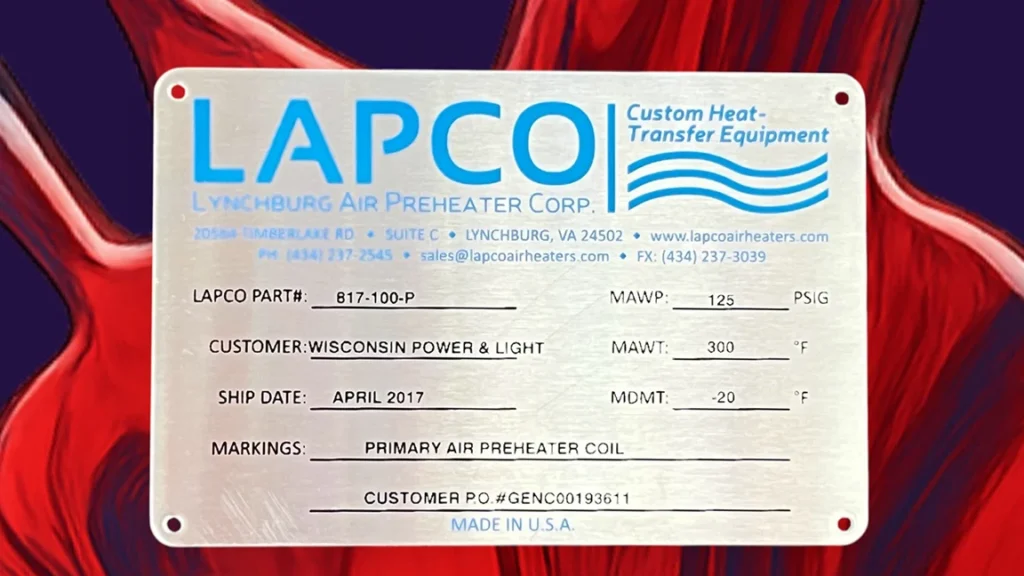
A product identifier is the unique code or mark that sets one product apart from every other and lets it be tracked through manufacturing, sale, and service. It can be a part number, a model number, a serial number, or a barcode or QR code, and it usually lives on a nameplate, decal, tag, or overlay built to stay readable for the life of the product.
What Are the Main Types of Product Identifiers?
Product identifiers come in a handful of common types, and most products carry more than one at a time. Some stay the same across a whole product line, and others are unique to a single unit.
Part Number
Identifies a specific product or component within a line. Every unit of the same part shares the same part number.
Model Number
Names the product design or version. Like a part number, it is shared by every unit of that model.
Serial Number
Unique to one individual unit. A serial number is how a single item gets tracked for warranty, service, and recalls.
Lot or Batch Number
Ties a unit to the production run it came from, which matters for quality tracking and recalls.
Barcode
Encodes a number or code so it can be scanned instead of typed by hand. Barcodes speed up inventory and handling.
QR Code
Holds more than a barcode and can link to records, manuals, or a part lookup when scanned with a phone.
What’s the Difference Between a Serial Number and a Part Number?
A part number identifies what a product is, and a serial number identifies which specific unit it is. The part number is shared by every identical unit, while the serial number is unique to one. Here is how they compare:
| Serial number | Part number | |
|---|---|---|
| Identifies | One individual unit | A product or component type |
| Shared or unique | Unique to each unit | Shared across every identical unit |
| Changes per unit | Yes | No |
| Typical use | Warranty, service, recalls, asset tracking | Ordering, cataloging, specifying |
What Products Carry a Product Identifier?
A product identifier has to live on something, and that carrier is chosen to match the product and the environment it works in. These are the carriers we manufacture most often.
Metal Nameplates
The durable standard for ratings, serial numbers, and model data on equipment. Aluminum, stainless steel, and brass nameplates stay readable through years of outdoor and industrial exposure.
Decals and Placards
A printed film with an industrial adhesive, good for rating, warning, and barcode identification. Decals and placards conform to curved surfaces that a rigid plate can’t.
Tags
Metal and plastic tags hang from or attach to valves, cables, and equipment, often serialized or barcoded for asset tracking.
Graphic Overlays
Graphic overlays bring branding, labeling, and control markings together on a single printed face for panels and equipment.
How Are Product Identifiers Marked?
The marking method decides how sharp the identifier looks and how long it lasts. We run every major process in house and match it to the material, the environment, and the run size.
Screen Printing
Screen printing lays down thick, opaque, UV-resistant color. It is a reliable choice for long-lasting outdoor nameplates.
Digital Printing
Digital printing handles short runs, full color, and fine detail, and it is a good fit for variable data and fast turnaround.
UV Printing
UV printing cures ink that bonds directly to a wide range of materials, with high resolution and strong durability.
Chemical Etching
Chemical etching recesses the image into metal so it resists wear, which suits demanding environments.
Laser Engraving
Laser engraving leaves a permanent, high-contrast mark with no ink or coating to wear off.
Variable Data Printing
Variable data printing applies serialized barcodes, QR codes, and sequential numbering so every unit in a run is marked uniquely.
Why Do Product Identifiers Matter?
A product identifier does more than label a product. It connects that product to its records for everyone who handles it after it leaves the factory.
- Traceability — a serial number or barcode links each unit back to its part number, batch, and service history.
- Warranty and service — technicians can pull the right manual, parts, and coverage from the number on the plate.
- Inventory and asset management — scannable identifiers let teams count, locate, and audit equipment quickly.
- Recalls and compliance — when units have to be pulled or checked, the identifier shows exactly which ones are affected.
- Brand consistency — a clean, consistent identifier carries the manufacturer’s name and quality across every product line.
How Do You Choose the Right Product Identifier?
The right identifier comes down to what the product needs and where it will live. These are the factors worth settling up front.
- Fixed or variable data — decide whether every unit shows the same information or each one needs a unique serial number, barcode, or QR code.
- Environment — indoor, outdoor, UV, heat, chemicals, and abrasion all point toward different materials and marking methods.
- Required service life — how many years the identifier has to stay readable.
- Carrier and mounting surface — the product’s surface and shape decide whether a nameplate, decal, tag, or overlay fits best.
- Volume and scale — prototype quantities and full production runs can call for different methods.
- Compliance — any marks the product has to display, such as UL.
Frequently Asked Questions About Product Identifiers
What is an example of a product identifier?
A serial number stamped on a machine is a common example of a product identifier. So is a model number on an appliance, a part number on a component, or a barcode on a shipping label.
Is a serial number a product identifier?
Yes. A serial number is one type of product identifier, and it is the one that points to a single, individual unit rather than a whole product line.
What is the difference between a product identifier and a barcode?
A product identifier is the code or mark itself, such as a serial number or part number. A barcode is one way to encode that identifier so a scanner can read it.
Can one product have more than one identifier?
Yes. Most products carry several product identifiers at once, such as a model number, a serial number, and a barcode, each doing a different job.
Where does a product identifier go on a product?
A product identifier goes on a carrier built to last, usually a nameplate, decal, tag, or graphic overlay attached to the product and matched to its environment.
Is a Data Plate a Type of Product Identifier?
A data plate is one of the most common ways a product identifier gets carried, not an identifier on its own. It gathers several identifiers in one place, usually the manufacturer, model, serial number, and ratings, on a single durable plate. When those identifiers have to survive years of heat, sun, and handling, a data plate is usually where they end up.
Your Partner for Product Identification
From the first part number to full production runs, we manufacture the nameplates, decals, tags, and overlays that carry your product identifiers, and we help you pick the right material and marking method for each one.
Request a quote or talk to a product identification expert to get started.