
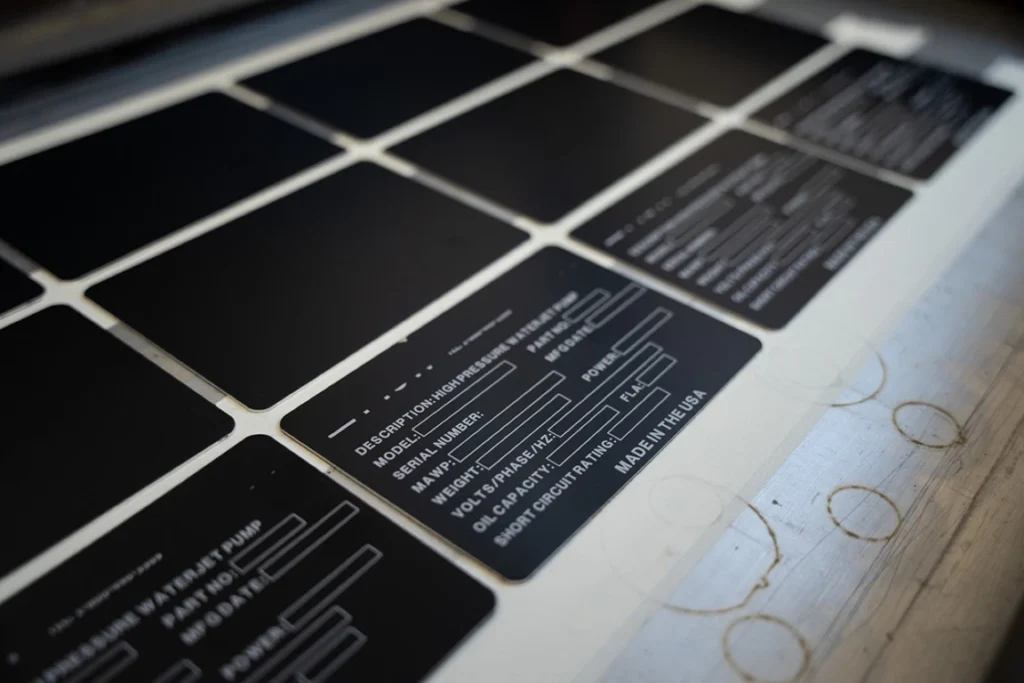
A data plate is a durable identification plate fixed to a product or piece of equipment that displays its key identifying and technical information — manufacturer, model and serial number, ratings, and specifications — in a form built to stay legible for the life of the product.
Inside This Article
- What Is a Data Plate?
- What Information Is on a Data Plate?
- What Are Data Plates Made Of?
- How Are Data Plates Manufactured?
- What Are the Different Types of Data Plates?
- Where Are Data Plates Used?
- How Long Do Data Plates Last?
- How Do You Choose the Right Data Plate?
- Data Plate vs. Nameplate: What’s the Difference?
- Frequently Asked Questions About Data Plates
What Is a Data Plate?
A data plate is a permanent label, usually made of metal or rigid plastic, that records the information needed to identify a product and understand how to use and service it. It is attached directly to the equipment it describes and is engineered to survive the same conditions that equipment does — heat, abrasion, chemicals, sunlight, and years of handling.
The term is used across industries for the small plate that answers a simple question: what is this, who made it, and what are its limits? On a compressor it might list pressure ratings; on an electrical enclosure, voltage and amperage; on a pump, flow and horsepower. The common thread is that the information has to remain readable long after the product leaves the factory, which is why a data plate is built differently from an ordinary printed label.
What Information Is on a Data Plate?
The exact fields vary by product and industry, but most data plates carry some combination of:
- Manufacturer name and logo
- Model or part number
- Serial number
- Date of manufacture
- Electrical ratings (voltage, amperage, wattage, phase)
- Performance ratings (pressure, capacity, flow, horsepower, load)
- Weight
- Country of origin
- Certification marks, such as UL
- Warnings and operating instructions
- Variable data (barcodes, QR codes, or sequential serial numbering that uniquely marks each unit so it can be scanned and tracked)
Variable data is what makes a plate useful for inventory, warranty claims, maintenance records, and field service.
What Are Data Plates Made Of?
Data plates are made from durable metals and rigid plastics — most commonly aluminum, stainless steel, brass, Metalphoto® anodized aluminum, polycarbonate, polyester, and rigid vinyl. Material is the first decision, because it determines how long the plate stays readable and what conditions it can take, and we match it to the environment the product will live in.
Aluminum
Lightweight and strong, with high resistance to oxidation, abrasion, and corrosion. The most common choice for general industrial identification.
Stainless Steel
Extremely durable, holds its finish, and withstands abrasion for years. Chosen where strength and a premium appearance both matter.
Brass
Handles temperature extremes, salt spray, and sun exposure. Well suited to demanding or outdoor settings.
Metalphoto® Anodized Aluminum
Photosensitive anodized aluminum with the image sealed inside the anodic layer, for excellent resistance to heat, abrasion, chemicals, and UV. The choice for high-resolution plates that must stay legible for decades; NPI is a certified converter.
Polycarbonate, Polyester, and Rigid Vinyl
Durable plastic options for plates and overlays that need flexibility, texture, or lower cost while standing up to wear and the elements.
Metal data plates are available in thicknesses from .003″ to .125″, so the plate can be specified as a thin, conformable foil or a rigid plate depending on how it mounts.
How Are Data Plates Manufactured?
Producing a data plate runs through a consistent sequence, from specification to a finished, ready-to-apply plate.
- Specification and artwork. We confirm the information, layout, material, size, and mounting method, then prepare print-ready artwork and any variable data such as serial numbering or QR codes.
- Material selection. The substrate is chosen for the product’s environment — aluminum, stainless steel, brass, Metalphoto® anodized aluminum, or a durable plastic.
- Marking. The image is applied by the process best suited to the material and run size: screen printing, digital printing, UV printing, chemical etching, laser engraving, or the Metalphoto® photographic process.
- Finishing. Protective coatings, laminates, or anodized sealing are applied where the environment calls for added resistance to UV, chemicals, or abrasion.
- Cutting and forming. Plates are cut to size and shape by custom die cutting or laser cutting, with holes, corners, or contours as specified.
- Adhesive and backing. A specialty adhesive or other mounting method is applied and matched to the surface the plate will bond to.
- Quality check and delivery. Plates are inspected against the specification and prepared for shipment.
Because we run all of these processes in house under an ISO 9001:2015-certified quality system, material, marking method, and finish are chosen together rather than forced to fit one capability.
What Are the Different Types of Data Plates?
Data plates are often grouped by the job they do on the product.
Equipment and Machine Data Plates
The core technical record (ratings, model, serial number) on industrial machinery and components.
Rating Plates
The performance and safety limits, such as electrical or pressure ratings, an operator or inspector needs at a glance.
Serial Number and Asset Plates
Identify an individual unit for tracking, warranty, and asset management, often with barcodes or QR codes.
Instruction and Warning Plates
Combine identification with operating guidance or safety notices.
Variable-Data Plates
Use sequential numbering, barcodes, or QR codes so every unit in a run is uniquely marked and scannable.
Many data plates combine several of these roles on a single plate.
Where Are Data Plates Used?
Almost any manufactured product that needs to be identified, rated, or tracked carries a data plate. Common settings include:
- Industrial equipment — machinery, motors, and components that need permanent ratings and identification.
- Oil and gas — equipment that must stay identified through heat, pressure, and corrosive conditions.
- HVAC — units and components carrying model, serial, and performance data.
- Electrical — enclosures, controls, and assemblies with voltage and rating information.
- Aerospace and aviation — components requiring durable, traceable identification.
- Fleet and transportation — vehicles and equipment needing asset and serial identification.
How Long Do Data Plates Last?
Service life depends on the material and the environment. The figures below are typical ranges for identification products in real-world use.
| Material | Best suited for | Typical service life |
|---|---|---|
| Metalphoto® anodized aluminum | Long-term outdoor and harsh environments | Up to 20+ years outdoor |
| Stainless steel | Demanding industrial and outdoor use | Many years, highly abrasion resistant |
| Aluminum | General industrial identification | Long service life; varies with finish |
| Brass | Temperature extremes, salt spray, sun | Long outdoor service life |
| Polycarbonate / polyester | Panels, overlays, indoor and sheltered use | Several years, longer indoors |
| Vinyl | Cost-effective labeling | Up to 8 years outdoor with UV-inhibiting laminate |
Metal identification plates can be built to withstand up to 25 years of outdoor exposure when the material, finish, and adhesive are specified for the conditions.
How Do You Choose the Right Data Plate?
The right plate is the one matched to where it will live and what it has to do. The main factors to weigh:
- Environment — indoor, outdoor, UV exposure, temperature, chemicals, and abrasion the plate will face.
- Required service life — how many years the information must stay legible.
- Information and data — fixed text only, or variable data such as serial numbers, barcodes, or QR codes.
- Mounting surface — the material and shape the plate bonds to, which drives adhesive choice.
- Size and format — flat plate, conformable foil, or a shaped part with holes or contours.
- Appearance — finish, color, and whether a premium look is part of the product’s branding.
- Compliance — any certification marks, such as UL, the plate needs to display.
A short conversation about the application usually settles the material and process quickly — which is where our engineering support comes in.
Data Plate vs. Nameplate: What’s the Difference?
A data plate emphasizes a product’s technical and identifying data — ratings, serial number, and specifications — while a nameplate emphasizes identification and branding, such as the company name, logo, and model. The two terms overlap, and a single plate often does both jobs; which word a customer uses usually comes down to industry habit. Here is where the emphasis differs:
| Data plate | Nameplate | |
|---|---|---|
| Primary purpose | Technical and identifying data | Identification and branding |
| Typical content | Ratings, serial number, specifications | Company name, logo, model |
| Emphasis | Information and traceability | Appearance and brand presence |
| Overlap | Often carries branding too | Often carries data too |
Frequently Asked Questions About Data Plates
What is a data plate used for?
A data plate identifies a product and records the technical information needed to use, service, and track it — manufacturer, model, serial number, ratings, and specifications.
What is the best material for a data plate?
The best data plate material depends on the environment. Metalphoto® anodized aluminum and stainless steel are strong choices for long-term outdoor and harsh conditions, while aluminum suits most general industrial identification.
Can a data plate include a barcode or QR code?
Yes — a data plate can carry variable data such as barcodes, QR codes, and sequential serial numbering, so each unit is uniquely marked and scannable.
How are data plates attached?
Data plates are most often attached with a specialty adhesive matched to the mounting surface, and can also be specified with holes for mechanical fastening.
Which Material Makes a Data Plate Last Decades?
A data plate built to last decades is made of metal. Plastics serve well for sheltered or short-term use, but where a plate faces years of sun, heat, chemicals, and abrasion, a metal substrate is what keeps the image readable — and the right one depends on the environment, from economical aluminum to corrosion-resistant stainless steel and brass to Metalphoto® anodized aluminum for the harshest exposure. For those long-life applications, metal nameplates and data plates are the durable standard, with substrate, finish, and adhesive matched together so the plate stays legible for the full life of the product.
Your Complete Source for Durable Data Plates
From material selection to marking, finishing, and adhesive, we manufacture data plates built to stay readable for the life of your product — backed by ISO 9001:2015-certified quality and more than 50 years of experience.
Request a quote or talk to a product identification expert to get started.